
The silver crescent of Shaban ascends the night sky which brings deep anticipation to worldwide observers. We find ourselves standing at the threshold of a night often described as the Night of Records or the Night of Fortune. Shab-e-Barat in Islam functions as a lunar calendar date which serves as a spiritual gateway that provides every soul the chance to start anew before Ramadan begins. People see this night as their connection between human weaknesses and their upcoming period of receiving God’s compassion. It is a time when the atmosphere feels heavy with blessings and the whispers of heartfelt prayers.
Visit Now:https://duaguidance.com/
What is Shab-e-Barat in Islam? (Meaning & Background)
The term Shab-e-Barat is a beautiful blend of Persian and Arabic. Shab means night, while Barat translates to freedom or exoneration. The Islamic term Shab-e-Barat describes the Night of Deliverance which Allah (SWT) uses to release His servants from their sinful burdens and protect them from Jahannam fire.
The Arabic-speaking world refers to this night as Laylat-ul-Bara’ah or Nisf Shaban which means the middle of Shaban. The Quran identifies the Blessed Night (Laylatum Mubarakah) in Surah Ad-Dukhan but scholars and commentators have associated the mid-Shaban period with this special night of divine decree throughout history.
Importance and Significance of Shab-e-Barat in Islam
Why does this night hold such a sacred place in the hearts of the Ummah? Muslims observe Shab-e-Barat in Islam because they believe that God determines the upcoming year’s fates during this special night. The time allows for God to review and decide on matters about human existence and their life’s essentials.
The night provides more than administrative tasks because it offers people the chance to experience deep connections with the Divine. Allah (SWT) comes down to the lowest heaven on this night to address His creation by declaring:
“Is there anyone seeking forgiveness so that I may forgive him? Is there anyone seeking provision that I may provide for him? Is there anyone under trial that I may relieve him of?”
The call stays available until dawn breaks because it invites all exhausted people to discover rest under Allah’s merciful protection.
Also Read: The Last 10 Days of Ramadan: A Time for Mercy, Forgiveness & Salvation
Virtues of Shab-e-Barat According to Islamic Teachings
The virtues of Shab-e-Barat in Islam are rooted in the pursuit of spiritual purification. While scholars may have varying views on the strength of specific narrations, the collective essence of Islamic tradition emphasizes that this is a night of exceptional grace.
- Mass Forgiveness: The number of people who Allah forgives on this night exceeds the total number of hairs that exist on all the sheep in the Kalb tribe.
- A Preparation for Ramadan: This night functions as a spiritual preparation that enables people to dedicate themselves fully to the upcoming Ramadan devotion.
- Strengthening Community: The night serves as a traditional time when families honor their deceased relatives by visiting their graves which helps them remember that life on earth is temporary while the Hereafter lasts forever.
Best Night Prayers to Perform on Shab-e-Barat
While there is no obligatory set of prayers specific only to this night, the beauty of Shab-e-Barat in Islam is the freedom to engage in voluntary (Nawafil) worship. If you want to receive maximum rewards from your activities then you should follow these guidelines.
1. Salat-ul-Tasbih
The prayer in which people worship Allah through 300 glorifications of His name is beautiful. It is highly recommended for seeking the forgiveness of all types of sins past, present, hidden, or manifest.
2. Tahajjud (The Late Night Prayer)
The quietest part of the night is when the connection between the Creator and the created is strongest. Standing in the darkness of the night, pouring your heart out in Sujood (prostration), is perhaps the most sincere way to honor the night.
3. Recitation of the Holy Quran
When people meditate on Allah’s words it brings them special peace which exists nowhere else. The three Surahs to study are Surah Yasin and Surah Ar-Rahman and Surah Al-Mulk to understand His greatness and His compassion.
Recommended Duas for Forgiveness and Mercy
The most powerful tool on the night of Shab-e-Barat in Islam is your tongue and your tears. There is no language barrier between you and your Lord. However, following the Sunnah is always a light for the soul.
- The Sayyid al-Istighfar:
“O Allah, You are my Lord, there is no god but You. You created me and I am Your servant… I acknowledge Your favor upon me and I acknowledge my sin, so forgive me…” - Dua for General Well-being: Ask for Afiyah (well-being) in this world and the next. You should request that your family receive safety protection while all difficulties which affect the worldwide Muslim community should be eased.
What to Do and What to Avoid
To achieve genuine benefits from Shab-e-Barat in Islam Muslims need to achieve a combination between their enthusiastic behavior and accurate religious observance.
What to Do:
- Fast on the 15th of Shaban: The practice of fasting on Shabaan 15th represents a Sunnah which Muslims should observe. Muslims who hold a grudge against another Muslim should seek to forgive their opponent.
- Make Amends: People who hold malicious feelings toward others will experience loss of the complete blessings which occur during the night.
- Charity: The act of charity requires you to donate even the smallest amount to assist people who require help.
What to Avoid:
- Innovations (Bida’h): People should stay away from all activities which do not follow Shariah rules because these activities include fireworks displays and excessive decorations and organized “party-like” atmospheres.
- Missing Fajr: The worst disaster occurs when someone spends the entire night praying voluntarily yet fails to perform the mandatory Fajr prayer.
- Arrogance: People should not consider themselves superior to others who choose not to pray because they should practice humility during the night instead of showing their religious devotion.
Common Misconceptions Explained
In the cultural observance of Shab-e-Barat in Islam, certain myths have surfaced over time. It is important to address these gently:
- The Special 100 Rakat: While you can pray as much as you like, there is no specific 100 Rakat prayer mandated by the Prophet (PBUH). The quality of Khushu (focus) is better than quantity.
- Soul Visits: Some believe the souls of the departed visit their homes on this night. The practice of praying for the dead lacks biblical foundations yet it provides righteous benefits which help deceased people no matter where they exist.
Also Read: Ramadan Daily Duas for Peace, Mercy & Barakah
Conclusion
The occasion of Shab-e-Barat in Islam holds important value because it demonstrates that Allah shows mercy during all times while special occasions help us revive our dormant spiritual awareness.
This night is your chance to close the dusty books of the past and open a clean, white page for the future. Don’t let the night pass by while you are scrolling through social media or lost in idle talk. Instead, find a quiet corner, raise your hands, and let your heart speak. He is Al-Ghaffar (The Repeatedly Forgiving) and He is waiting to hear your voice.
The present night will serve as a decisive moment which will guide us through Ramadan, a month that brings us enlightenment and direction and divine approval.
FAQ’s
What is Shab-e-Barat in Islam?
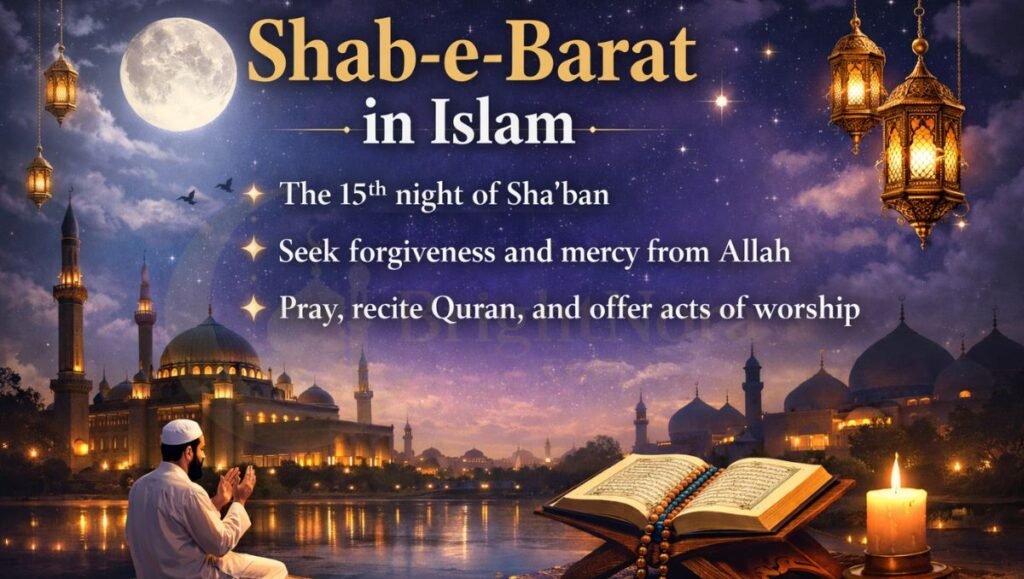
Shab-e-Barat in Islam is the 15th night of Sha‘ban, observed as a night of forgiveness, mercy, and sincere repentance.
Why is Shab-e-Barat important for Muslims?
Many Muslims consider it a special night to seek Allah’s forgiveness, mercy, and spiritual renewal.
What acts of worship are done on this night?
Believers offer nafl prayers, recite the Quran, make dua, and engage in dhikr.
Is fasting recommended after Shab-e-Barat in Islam?
Fasting on the 15th of Sha‘ban is practiced by some Muslims, but it is optional and not compulsory.
Is Shab-e-Barat in Islam mentioned in the Quran?
The night is not directly mentioned in the Quran, but its virtues are discussed in some Hadiths and scholarly views.