
How the Prophet ﷺ spent Ramadan: Ramadan is more than just a month of hunger and thirst; it is a spiritual transformation that reorients the heart toward its Creator. The Messenger of Allah ﷺ serves as the best example for Muslims who want to achieve the perfect guide through this holy month. The Prophet’s ﷺ Ramadan observance shows us how to worship God through our actions instead of following empty rituals. His activities throughout this month showed his full dedication to God while he practiced his religious obligations through his generous acts and simple way of living.
Visit Now:https://duaguidance.com/
How the Prophet ﷺ Prepared for Ramadan
The Prophet’s ﷺ preparation for Ramadan started before the first night of the holy month. Instead, he started conditioning his soul during the month of Sha’ban. Aisha (may Allah be pleased with her) narrated that she never saw the Messenger of Allah ﷺ fasting more in any month than he did in Sha’ban (Bukhari).
He started his voluntary fasting practice before Ramadan because he wanted to achieve complete bodily and spiritual control at the start of the holy month. He would also welcome the month with hope, famously saying:
“When the month of Ramadan starts, the gates of heaven are opened and the gates of Hell are closed and the devils are chained.” (Sahih Bukhari)
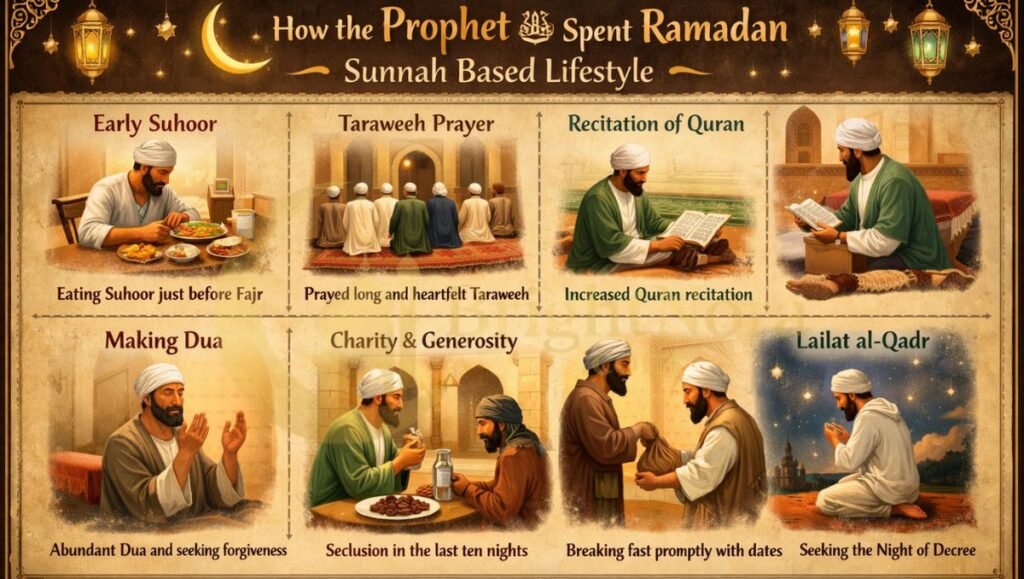
The Prophet’s ﷺ Fasting Routine: Suhoor and Iftar
When we look at how the Prophet ﷺ spent Ramadan, his approach to food was centered on barakah (blessing) rather than indulgence.
The Blessed Pre-Dawn Meal (Suhoor)
The Prophet ﷺ insisted on the importance of Suhoor, calling it a “blessed meal.” He would delay it until the last possible moments before Fajr, teaching us that there is ease in the Sunnah.
Breaking the Fast (Iftar)
In contrast to Suhoor, the Prophet ﷺ was quick to break his fast as soon as Maghrib entered. He typically broke his fast with a few fresh dates (rutab), or dry dates (tamr) if fresh ones weren’t available. He would drink water in small amounts when there were no dates available to him. The simplicity of the practice allowed people to concentrate on their prayers and their spiritual appreciation of the time.
Daily Worship Practices of the Prophet ﷺ in Ramadan
The daily schedule of the Messenger ﷺ was filled with a constant connection to Allah. If we want to emulate how the Prophet ﷺ spent Ramadan, we must look at his three pillars of daily worship:
1. The Regularity of Salah
While the five daily prayers were the foundation, the Prophet ﷺ increased his voluntary prayers. He remained deeply focused, ensuring that every movement in Salah was performed with Khushu (humility).
2. Deep Connection with the Qur’an
Ramadan serves as the time when Muslims celebrate the Qur’an. The Angel Jibreel (AS) visited the Prophet ﷺ every night to study the Qur’an with him during this time (Bukhari).The Quran requires people to read during Ramadan but they should also spend time studying and meditating on its teachings.
3. Constant Dhikr and Dua
Muslims use Ramadan to celebrate the Qur’an which they consider their holy book. The Angel Jibreel (AS) visited the Prophet ﷺ every night to study the Qur’an with him during this time (Bukhari).The Quran requires people to read during Ramadan but they should also spend time studying and meditating on its teachings.
Also Read: Shab-e-Barat in Islam: Meaning, Importance & Night Prayers
Night Prayers and Qiyam-ul-Layl
One of the most beautiful aspects of how the Prophet ﷺ spent Ramadan was his dedication to the night prayer. While he prayed Tahajjud throughout the year, his effort in Ramadan was unparalleled.
He encouraged the Ummah to stand in prayer, saying:”Whoever establishes prayers during the nights of Ramadan faithfully out of sincere faith and hoping to attain Allah’s rewards, all his past sins will be forgiven.” (Bukhari)
Whether prayed in congregation (as Tarawih) or individually in the depth of the night, these prayers were long, rhythmic, and filled with tears of devotion.
The Prophet ﷺ in the Last Ten Days of Ramadan
As the month reached its peak, the Prophet’s ﷺ intensity increased. He would “gird his loincloth,” stay awake all night, and wake his family to join him in worship.
The Practice of I‘tikaf
To completely detach from the world, the Prophet ﷺ would perform I‘tikaf (seclusion in the Masjid) during the last ten days. This allowed him to focus entirely on his relationship with Allah, away from the distractions of daily life.
Seeking Laylatul Qadr
The primary goal of this seclusion was to seek Laylatul Qadr (The Night of Decree), which is better than a thousand months. He instructed us to: “Search for the Night of Qadr in the odd nights of the last ten days of Ramadan.” (Bukhari)
Charity and Kindness During Ramadan
The Prophet ﷺ was naturally the most generous of people, but his generosity reached its peak in Ramadan. Ibn Abbas (RA) described him during this month as being “more generous than the blowing wind” (Bukhari).
In how the Prophet ﷺ spent Ramadan, we see a man who:
- Provided Iftar for the poor.
- Increased his Sadaqah (voluntary charity).
- Was even more accessible to those in need.
He taught us that fasting should soften our hearts toward the less fortunate, turning our hunger into empathy and our empathy into action.
The Prophet’s ﷺ Simple Lifestyle While Fasting
The current Ramadan festivities in modern times focus on both expensive food celebrations and decorative displays. The Sunnah-based way of life existed as a highly simple practice. The Prophet Muhammad ﷺ maintained a simple living space throughout his life.
He spent his time awake between napping and consuming his meals. He maintained his active schedule during Ramadan through his responsibilities of leading military missions and administering community duties. His way of life demonstrates that Muslims should use Ramadan as a period of active work instead of remaining inactive.
Lessons Muslims Can Apply Today
To truly follow how the Prophet ﷺ spent Ramadan, we can implement these practical steps:
- Prioritize the Qur’an: Set aside a specific time for Tadabbur (reflection), not just completion.
- Simplify your Iftar: Your Iftar needs to be simplified through your kitchen time reduction which allows you to spend more time on the prayer mat.
- Practice Character Fasting: People who observe fasting should stop backbiting and angry behavior and all useless speech because the Prophet ﷺ taught that bad speech must be avoided for fasting to be valid.
- Be a Source of Good: Your charitable donations should increase through you because even small amounts of your donations contribute to good deeds.
Also Read: Ramadan Worship Guide: Prayers, Duas & Good Deeds
Conclusion
How the Prophet ﷺ spent Ramadan: The way the Prophet ﷺ observed Ramadan shows his life dedicated to worship and self-control and his strong affection for God. The most appropriate method to respect this holy month according to him involves maintaining mental focus while reciting Allah’s name and performing acts of generosity.
The upcoming sacred month shows us the opportunity to restore these Sunnah practices. We ask Allah to help us reach Ramadan while He gives us strength to follow the worship practices that the Prophet ﷺ established.
FAQ’s
How the Prophet ﷺ spent Ramadan in daily worship?
How the Prophet ﷺ spent Ramadan was centered on increased prayers, sincere fasting, remembrance of Allah, and consistent acts of worship.
How the Prophet ﷺ spent Ramadan during the nights?
How the Prophet ﷺ spent Ramadan nights included Qiyam-ul-Lail, Tahajjud, heartfelt dua, and deep spiritual reflection.
What was the relationship of the Prophet ﷺ with the Quran in Ramadan?
The Prophet ﷺ regularly recited the Quran and revised it with Angel Jibreel (AS) during the blessed month.
How the Prophet ﷺ spent Ramadan by showing generosity?
How the Prophet ﷺ spent Ramadan showed unmatched generosity through charity, helping the poor, and supporting those in need.
How the Prophet ﷺ spent Ramadan following Sunnah practices?
How the Prophet ﷺ spent Ramadan by following Sunnah included patience, good character, controlling speech, and seeking Laylatul Qadr.