Eid al-Fitr Zakat fitrana: With the sighting of the Shawwal moon, joy leaps up in all hearts; yet for a thoughtful Muslim, this time is not only a festival but also a very deep period of spiritual reflection and meditation. Although Eid is a day of joy, its splendor is blemished if we do not make the less privileged ones of our society celebrate with us, through our support.
Knowing the rules of Zakat, Fitrana for Eid al-Fitr is a necessity for your worship to be accepted, and for your donation to get to the needy in accordance with the Sunnah. We will explain these duties in this guide, but in a way that will not feel like a tedious manual but a loving roadmap for your end of Ramadan journey.
The Heart of Giving: Why Charity Defines Eid
In Islam, giving is not merely an act of charity; it is a tool through which social justice can be achieved. It purifies our wealth and our fasts. If you’ve ever felt like your Ramadan wasn’t perfect, perhaps a moment of anger or a slip of the tongue, Zakat al-Fitr (Fitrana) acts as a beautiful patch for those holes.
When we talk about Eid al-Fitr, Zakat, Fitrana Rules, we are looking at two distinct but equally important pillars: the mandatory Fitrana (due before the Eid prayer) and the annual Zakat on wealth (if your anniversary falls in Ramadan).
Also Read: 10 Importance of Ramadan in Islam – Spiritual & Moral Benefits
Zakat al-Fitr (Fitrana): The Universal Duty
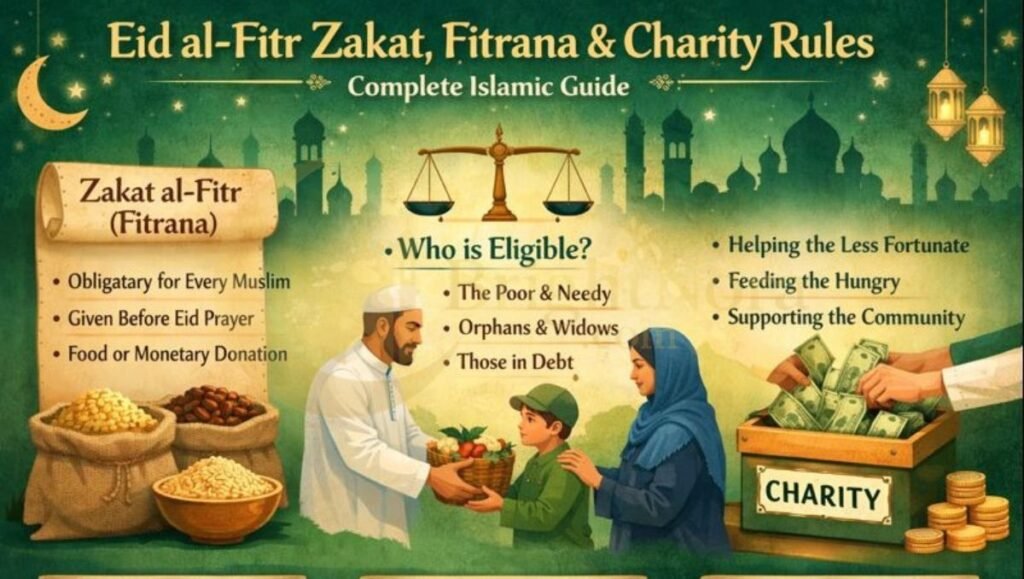
Unlike the annual Zakat on wealth, Fitrana is mandatory for every Muslim, regardless of age or gender, provided they have food in excess of their needs for one day and night.
Who Must Pay?
The head of the household usually pays on behalf of themselves and their dependents (children, spouse, and even domestic helpers if they are provided for). The goal is simple: to ensure no one goes hungry on the day of Eid.
When to Pay
Timing is everything. According to Eid al-Fitr Zakat, Fitrana Rules, the payment must be made before the Eid prayer begins. If you pay it after the prayer, it is considered ordinary charity (Sadaqah) rather than the obligatory Fitrana. Most scholars recommend paying it a few days early so that the poor have time to buy clothes or food for the festivities.
How Much to Pay?
Traditionally, the amount is equivalent to one Sa’ (four double handfuls) of food. In modern currency, this usually equates to the price of approximately 2kg of a local staple like wheat, barley, or rice. In 2026, many local mosques set a flat rate per person to make it easy for families to calculate.
Zakat al-Mal: The Annual 2.5%
While Fitrana is a small, fixed amount, Zakat al-Mal is the 2.5% calculated on your surplus wealth. Many people choose to pay this during Ramadan to reap the multiplied rewards of this holy month.
Also Read: Ramadan Kareem Ramadan – Blessings, Duas & Fasting Guide
The Nisab Threshold
Zakat is only compulsory when your wealth surpasses a specific amount, which is called Nisab. Usually, this amount is determined on the basis of the present market price of either 87.48 grams of gold or 612.36 grams of silver. When considering the Zakat of Eid al-Fitr, the rules of Fitrana should be followed since Zakat is imposed on.
- Cash stored in banks or at home.
- Gold and silver jewelry.
- Shares, stocks, and investment properties.
- Business goods.
Who is Eligible to Receive?
A common question people ask is, Can I give my Fitrana to my local mosque for repairs? The answer is generally no. Under the Eid al-Fitr Zakat, Fitrana Rules, these funds are specifically for the eight categories of people mentioned in the Quran, primarily the poor and the needy.
Pro Tip: You cannot give Zakat or Fitrana to your immediate vertical family your parents, grandparents, or children. However, giving to a brother, sister, or aunt who is struggling is actually encouraged, as it fulfills two roles: charity and strengthening family ties.
Avoiding Common Mistakes
To guarantee the recipient of your donation, follow the rules of Eid al-Fitr Zakat, Fitrana regarding the following aspects:
- Intention (Niyyah): It is necessary to pray along with your charity, putting your heart into it that the money is intended exclusively for Zakat or Fitrana, is extremely important.
- Direct Ownership: The person who receives it needs to have the right of ownership over the money or food. You cannot use Zakat money to build a bridge or a school; it must go to a person in need.
- Debts: If you owe money that is due immediately, you subtract that from your Zakat-eligible assets. However, long-term debts like a 20-year mortgage are usually handled differently—consult your local scholar for your specific situation.
The Spirit of the 2026 Giving Season
In today’s digital age, paying your Zakat has never been easier. Yet, along with simplicity comes the difficulty of validating the charity. So, make sure that the organization you are using adheres strictly to the rules of Eid al-Fitr Zakat, Fitrana, and operates with a 100% Zakat Policy, meaning they do not deduct any of your obligatory charity for administrative costs.
Moreover, try to look for those hidden poor. Sometimes, a neighbor who is too proud to ask or a relative who has fallen on hard times is more deserving of your attention than a distant anonymous fund.
Summary Table: Fitrana vs. Zakat
| Feature | Zakat al-Fitr (Fitrana) | Zakat al-Mal (Wealth Zakat) |
| Obligation | Every Muslim who has excess food for one day and night | Muslims whose wealth reaches the Nisab threshold |
| Amount | Fixed amount (approx. 2–2.5 kg of staple food or its cash value) | 2.5% of total eligible savings |
| Time of Payment | Before Eid al-Fitr prayer | After completing one lunar year (Hawl) on wealth |
| Purpose | To purify the fast and help the poor celebrate Eid | To purify wealth and ensure fair distribution |
| Beneficiaries | Poor and needy Muslims | Eligible Zakat recipients (as defined in Islam) |
Also Read: Eid al Fitr 2026 – Expected Date, Moon Sighting & Islamic Significance
Conclusion
Eid al-Fitr Zakat, Fitrana Regulations observance is not only a religious enlightenment but a shower of empathy, too. By computing our donation, we accept that God has bestowed the wealth upon us and hence part of it is for the needy.
As you prepare your finest clothes and your house fills with the scent of sweets, take a moment of quiet reflection. The assurance of having discharged the Eid al-Fitr Zakat, Fitrana Regulations brings an inner calm that is beyond any celebration. You aren’t just giving money; you are giving hope, dignity, and a reason for a stranger to smile on Eid morning.
May your fasting be accepted, wealth be filled with barakah, and the light of true generosity abound with your deen on this blessed Eid.
FAQ’s
What is Eid al-Fitr Zakat Fitrana?
Eid al-Fitr Zakat Fitrana is a mandatory charity given by Muslims before Eid prayer to purify the fast and help the needy celebrate Eid.
Who must pay Fitrana?
Every Muslim who has enough food or wealth to support themselves and their family must pay Fitrana for themselves and their dependents.
How much is Eid al-Fitr Zakat Fitrana?
The amount for Eid al-Fitr Zakat Fitrana is fixed, usually around 2–2.5 kg of staple food or its cash equivalent, per person.
When should Fitrana be paid?
Fitrana should be paid before the Eid al-Fitr prayer, so the poor can benefit and celebrate Eid on the same day.
Can Eid al-Fitr Zakat Fitrana be given in cash or food?
Yes, Eid al-Fitr Zakat Fitrana can be given in staple food like rice, wheat, dates, or as cash equivalent, depending on what benefits the needy the most.