

The period of Ramadan creates a special time when spiritual energy emerges at sunset when the day ends and people start to move in peaceful silence out of their active daytime mode. Our bodies face a challenge through fasting yet our spirits find refuge during the nighttime hours. The experience of standing before the Creator at night when the world sleeps creates a beautiful sacred experience. Ramadan Night Prayers are not merely a ritual; they are a conversation, a lifeline, and a transformative journey that heals the heart and elevates the spirit toward divine proximity.
Visit Now:https://duaguidance.com/
What is Qiyam ul Layl?
In Islamic terminology, Qiyam ul Layl literally translates to “standing at night.” The term describes all acts of voluntary worship which take place from the Isha prayer until the Fajr prayer.
The term Qiyam refers to more than official prayers because it includes:
- The Holy Qur’an recitation.
- Engaging in Dhikr (remembrance of Allah).
- Making heartfelt Duas.
In Ramadan, the congregational Taraweeh prayer is a beautiful form of Qiyam, allowing the community to unite under the shade of the Qur’an.
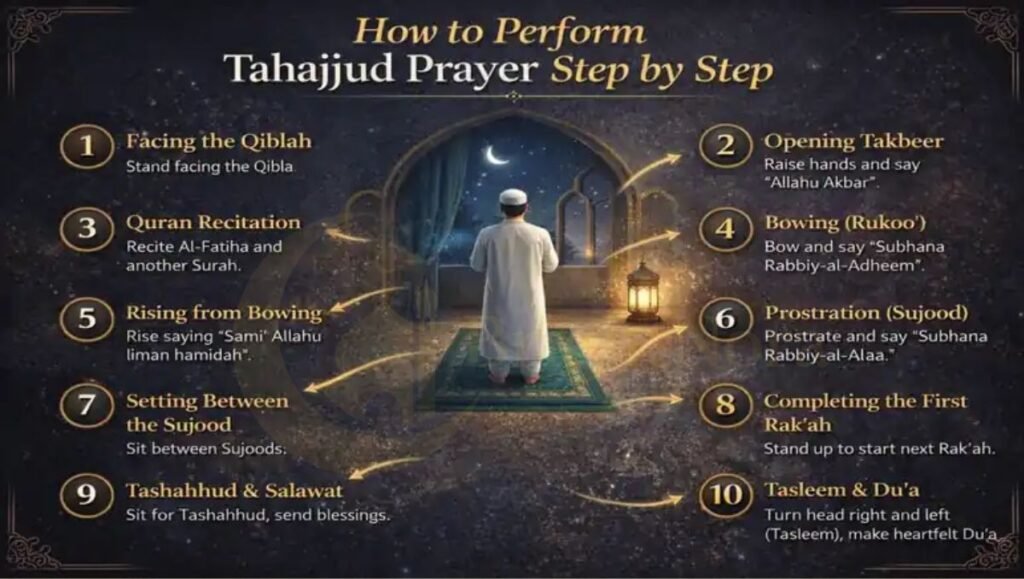
What is Tahajjud? Is it Different from Qiyam?
While the terms are often used interchangeably, there is a subtle distinction. Tahajjud specifically refers to the prayer performed in the latter part of the night after one has woken up from sleep.
The Prophet Muhammad (peace be upon him) said:
“The best prayer after the obligatory prayers is the night prayer.” (Sahiru Muslim)
Essentially, all Tahajjud is Qiyam, but not all Qiyam is Tahajjud. The act of sacrificing sleep to stand in prayer is what gives Tahajjud its immense spiritual weight and station of praise.
Also Read: Ramadan First Ashra – The 10 Days of Allah’s Mercy
Importance of Ramadan Night Prayers
Ramadan is the month of the Qur’an, and there is no better time to engage with the Word of Allah than during the quietude of the night. During this month, the rewards for voluntary deeds are multiplied, and the gates of mercy are flung wide open.
The night prayers during Ramadan provide Muslims with their necessary spiritual restoration which enables them to uphold their daytime fasting commitments. The Master and the slave share their closest connection during this time.
Powerful Benefits of Tahajjud & Qiyam
People who pray at 3:00 AM discover that their body faces challenges yet their spiritual rewards exceed all physical costs.
1. Spiritual Purification and Growth
The night prayer acts as a polish for the heart. It strips away the rust of worldly distractions and refocuses the soul on its ultimate purpose. It is a private act of worship, free from the showing off (Riya) that can sometimes affect public deeds.
2. Unmatched Closeness to Allah
In a famous Hadith Qudsi, we are told that Allah descends to the lowest heaven in the last third of the night, asking:
“Who is calling upon Me, that I may answer him? Who is asking of Me, that I may give him? Who is seeking My forgiveness, that I may forgive him?” (Bukhari)
3. The Acceptance of Duas
If you have a need, a heartache, or a dream, the time of Tahajjud is the “golden hour” for supplication. It is the time when the “arrows of the night” never miss their mark.
4. Inner Peace and Mental Clarity
The nighttime silence delivers an emotional break for people. The believer achieves complete peace of mind through their connection with Allah which leads to his daily strength.
5. Forgiveness of Sins
The act of standing in Qiyam with faith enables people to receive their rewards while it serves as a method to remove their previous sins. It is a spiritual “reset” button offered to us every single night of the holy month.
Special Significance in the Last 10 Nights
While every night of Ramadan is a treasure, the final ten nights contain the “Crown Jewel” of the Islamic calendar: Laylatul Qadr (The Night of Decree).
Praying during these nights is equivalent to praying for more than 83 years ($1,000$ months). The Prophet (PBUH) used to tighten his waist belt and exert himself in worship like no other time during these nights. Engaging in Ramadan Night Prayers during this period ensures you do not miss the immense blessings of the Night of Decree.
Practical Tips to Pray Tahajjud Consistently
The beloved of Allah show their faith through consistent behavior. To make the most of your nights, consider these steps:
- Eat Light at Iftar: A heavy stomach leads to a heavy head which results from eating heavy food at Iftar. The evening meal should be kept to moderate portions because excessive food intake will result in sleepiness.
- The Power Nap: The short nap known as Qailulah provides needed energy to remain awake after Dhuhr until nighttime.
- Sleep Early: People should avoid all social activities which are not necessary after Isha and Taraweeh.
- Use an Alarm: The alarm should be activated by placing your phone or clock at a distance which requires you to leave your bed for shutdown.
- Start Small: The two Rak’ahs which a person performs with sincere intention have greater value than complete absence of prayer.
Common Mistakes to Avoid
To achieve successful Qiyam, you must avoid these specific errors.
- Prioritizing Quantity Over Quality: The practice of reading multiple pages in a hurried manner without grasping their content proves less valuable than the act of reciting several verses while performing deep research.
- Neglecting Fard (Obligatory) Prayers: Tahajjud is a Sunnah. Do not stay up so late that you miss the Fajr congregation or sleep through the obligatory prayer.
- Strictly Following Others: Your Tahajjud is your private conversation. Don’t feel pressured to match someone else’s pace; find the rhythm that allows your heart to feel present.
Also Read: Laylatul Qadr 2026: Signs, Duas and Importance in Islam
Conclusion
The nights of Ramadan are fleeting shadows that pass all too quickly. Every minute dedicated to Ramadan Night Prayers serves as a dual purpose which brings you closer to your eternal life while helping you overcome your present challenges. You should not waste these valuable hours by sleeping or using digital devices.
You should use your prayer mat at midnight when everything becomes quiet. Pour out your heart, weep for your shortcomings, and ask for the impossible. Allah is listening, and He loves to give.
FAQ’s
What are Ramadan Night Prayers?
Ramadan Night Prayers are voluntary prayers offered at night, also called Tahajjud or Qiyam-ul-Layl, to seek Allah’s blessings.
When should I perform Ramadan Night Prayers?
They are ideally performed in the last third of the night, before Fajr, for maximum spiritual reward.
How many rakats should I pray in Ramadan Night Prayers?
There is no fixed number; commonly, people pray 2, 4, or 8 rakats in Ramadan Night Prayers, depending on their capacity and devotion.
What are the benefits of Ramadan Night Prayers?
They bring forgiveness, spiritual peace, closeness to Allah, and acceptance of supplications.
Can Ramadan Night Prayers be performed at home?
Yes, Ramadan Night Prayers can be performed anywhere, but offering them in congregation at home or mosque increases reward.