

For Muslims around the globe, the arrival of the holy month is a spiritual reset. The time period exists when heaven opens its gates and hell shuts its gates and every good deed receives multiplied rewards. The month requires more than food and drink prohibition to reach its objectives which need a Ramadan Worship Guide that will help them use every minute available. You can build your lifelong faith base through your daily activities because you practice intentionality and consistency for thirty days.
Visit Now:https://duaguidance.com/
Why Ramadan is the Best Month for Ibadah
The month of Ramadan serves as a physical endurance challenge while it provides an opportunity for people to achieve spiritual growth. The Quran was revealed during this month, specifically on Laylat al-Qadr (the Night of Decree), which is better than a thousand months.
In this sacred window, the Prophet Muhammad (peace be upon him) taught us that voluntary deeds are rewarded like obligatory ones, and obligatory deeds are multiplied seventy times over. This makes a Ramadan Worship Guide essential for anyone looking to maximize their “spiritual profit” and seek the ultimate goal: the forgiveness of Allah and protection from the Fire.
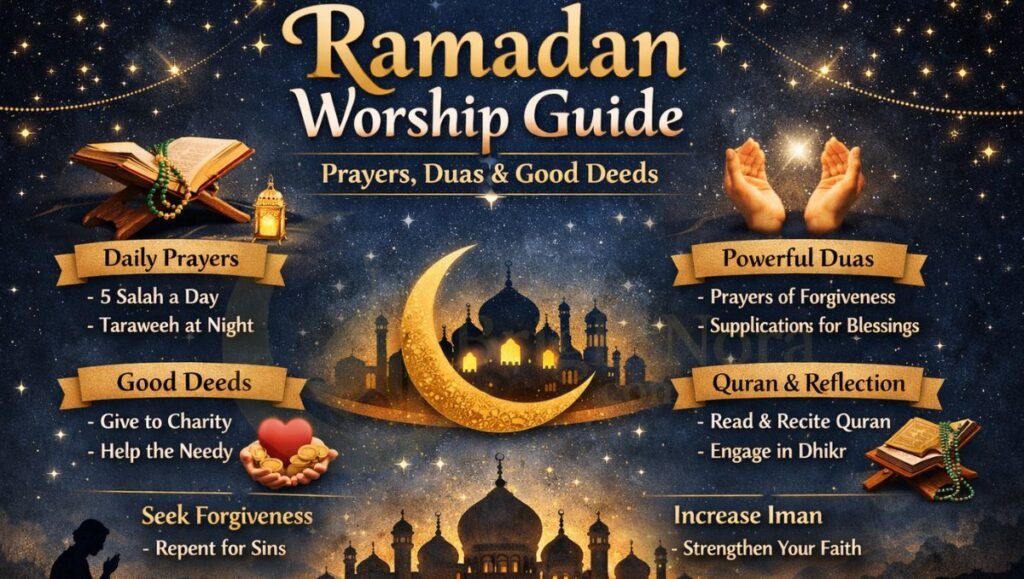
Daily Obligatory Prayers in Ramadan
The foundation of any Ramadan Worship Guide must be the five daily prayers (Salah). People tend to neglect their religious obligations because of the inability to resist the pleasure brought by offering extra prayers. The most important religious practice for Muslims to perform is their Fard (obligatory) prayers because these acts hold the highest value for Allah.
- Punctuality: The first prayer of the day should be performed at its earliest scheduled time.
- Congregation: For men, praying in the Masjid carries 27 times more reward.
- Focus (Khushu): Take your time in Sajdah (prostration). This is your direct line to the Creator.
Also Read: The Last 10 Days of Ramadan: A Time for Mercy, Forgiveness & Salvation
Special Ramadan Prayers: Taraweeh, Tahajjud, and Qiyam-ul-Layl
Beyond the five daily prayers, Ramadan offers unique opportunities to stand before Allah in the quiet of the night.
Taraweeh
Performed after the Isha prayer, Taraweeh is a Sunnah Mu’akkadah (highly recommended). Whether you pray eight or twenty units, the key is the quality of your recitation and your presence of heart.
Tahajjud and Qiyam-ul-Layl
The last third of the night is the most powerful time for worship. Following this Ramadan Worship Guide means waking up just 20 minutes before Suhoor (the pre-dawn meal) to pray even for two units of Tahajjud. This is the time when Allah descends to the lowest heaven, asking, “Who is calling upon Me, that I may answer him?”
Powerful Duas to Recite in Ramadan
Supplication (Dua) is the brain of worship. While you can speak to Allah in any language, certain traditional supplications are highly recommended:
- For Forgiveness: Allahumma innaka ‘afuwwun tuhibbul ‘afwa fa’fu ‘anni (O Allah, You are Forgiving and love forgiveness, so forgive me).
- At Iftar: Dhahaba al-zamau’ wabtallat al-‘urooq wa thabata al-ajru in sha Allah (The thirst is gone, the veins are moistened, and the reward is certain, if Allah wills).
- General Mercy: Rabbana atina fid-dunya hasanatan wa fil-akhirati hasanatan waqina ‘adhaban-nar.
Best Times to Make Duas During Ramadan
To follow a complete Ramadan Worship Guide, you must utilize the “golden hours” of acceptance:
- The hour before Iftar (while fasting).
- The last third of the night (Tahajjud time).
- The time between the Adhan and the Iqamah.
- While in prostration (Sajdah).
Good Deeds That Bring Maximum Reward
Fasting is the core, but these supplementary deeds round out a holistic Ramadan Worship Guide:
- Feeding the Fasting: Providing Iftar for someone earns you the same reward as their fast, without diminishing theirs.
- Charity (Sadaqah): The Prophet demonstrated his highest level of generosity during Ramadan because he gave more than any other person. Even a small daily donation counts.
- Quran Recitation: Aim to read a portion daily. The listeners should choose a recitation that includes translation because they need to understand the meaning (Tadabbur) which they cannot access through Arabic reading.
- Dhikir: You should maintain your tongue to remember Allah while you perform everyday activities such as cooking and commuting.
Simple Daily Worship Routine for Ramadan
Consistency is the secret to a successful month. Here is a sample schedule to integrate into your Ramadan Worship Guide:
| Time | Activity |
| Pre-Dawn | Suhoor, Tahajjud, and Fajr prayer. |
| Morning | Recite 5-10 pages of Quran; Dhikr during work/school. |
| Mid-Day | Dhuhr and Asr prayers; avoid gossip and idle talk. |
| Sunset | Make Dua 15 minutes before Iftar; break fast with dates. |
| Night | Isha and Taraweeh; rest early to wake for Tahajjud. |
Common Worship Mistakes to Avoid
A comprehensive Ramadan Worship Guide also highlights what to avoid:
- Overeating at Iftar: Lethargy prevents you from performing Taraweeh and Tahajjud.
- Social Media Addiction: Scrolling away the blessed hours reduces the spiritual “high” of the month.
- Focusing on Quantity over Quality: The practice of reciting the entire Quran at high speed without comprehension brings less value than spending time to study multiple Quranic verses.
How to Stay Consistent Throughout the Month
People begin their Ramadan festivities with strong enthusiasm, yet they experience complete exhaustion after 15 days. To maintain your practice:
- Start Small: If you can’t pray 20 rak’ahs of Taraweeh, do eight.
- Find a Buddy: You should worship together with someone who will help you stay on track.
- Renew Intentions: Every morning you should recall the reasons which motivate you to observe fasting.
Ramadan Worship Tips for Busy People
Your Ramadan Worship Guide requires different practices for students and working professionals, yet both paths lead to the same benefits.
- Audiobooks/Podcasts: During your commuting time, you should listen to Islamic lectures and Quran recitations.
- Micro-Worship: Use your 5-minute breaks to seek forgiveness.
- Intentional Sleep: You should sleep to refresh your body for worship, which will transform your sleep into a valuable sleep.
Also Read: Ramadan Daily Duas for Peace, Mercy & Barakah
Conclusion
Taqwa (God-consciousness) serves as the main objective, which you should pursue through your Ramadan Worship Guide. The month is viewed as a trial-run of the whole upcoming year. Ask yourself: Is my character improving? Am I becoming more patient, more generous, and more connected to my Creator?
Ramadan is a gift, a fleeting moment in time to scrub away the sins of the past and build a brighter spiritual future. May Allah accept your fasting, your standing in prayer, and every secret dua you whisper in the dark of the night.
FAQ’s
What is a Ramadan Worship Guide?
A Ramadan Worship Guide helps Muslims organize fasting, prayers, duas, and good deeds to gain maximum blessings during Ramadan.
Why is planning worship important in Ramadan?
Planning helps maintain consistency in ibadah, improves focus, and ensures time is used wisely throughout the holy month.
Which acts of worship are most important during Ramadan?
Fasting, obligatory prayers, Taraweeh, Quran recitation, charity, and sincere repentance are the most important acts.
How can someone stay spiritually motivated in Ramadan?
By setting daily goals, increasing remembrance of Allah, and surrounding oneself with positive Islamic reminders.
Can Ramadan worship improve a person’s character?
Yes, sincere worship in Ramadan builds patience, self-control, humility, and strengthens faith.